How to get your business recommended by ChatGPT

The short answer
You can't fill in a form or pay to be recommended inside a ChatGPT answer. ChatGPT searches the web when someone asks for a business, so it recommends the ones it can read clearly on their own website and see confirmed by other sites people trust.
The work is mostly unglamorous: consistent business details, a Google Business Profile you keep active, steady reviews, and pages written in the words your customers actually use.
Key takeaways
- AI assistants recommend businesses they can verify. In our test, the client's own website was cited in all 24 answers, and listing and review sites came next.
- Fix the boring thing first. Make your name, address and phone number match everywhere, including your signage.
- Write the way your customers talk. People ask AI in plain words, and your pages should answer in the same words.
- Before you change anything, ask AI your customers' questions and note which sites it cites. That tells you where to show up.
- Google still handles 85% of US searches (StatCounter, October 2026), and most of these steps help there too.
What happened when we asked AI about one of our clients
On November 7, 2026, we asked four AI assistants (ChatGPT, Perplexity, Gemini and Claude) three questions a patient near St. Joseph, Missouri might ask:
- "Who is the best orthopedic surgeon in St. Joseph, Missouri?"
- "Where should I go for orthopedic urgent care in St. Joseph, MO?"
- "I hurt my knee playing basketball. Where can I get it looked at in St. Joseph, Missouri?"
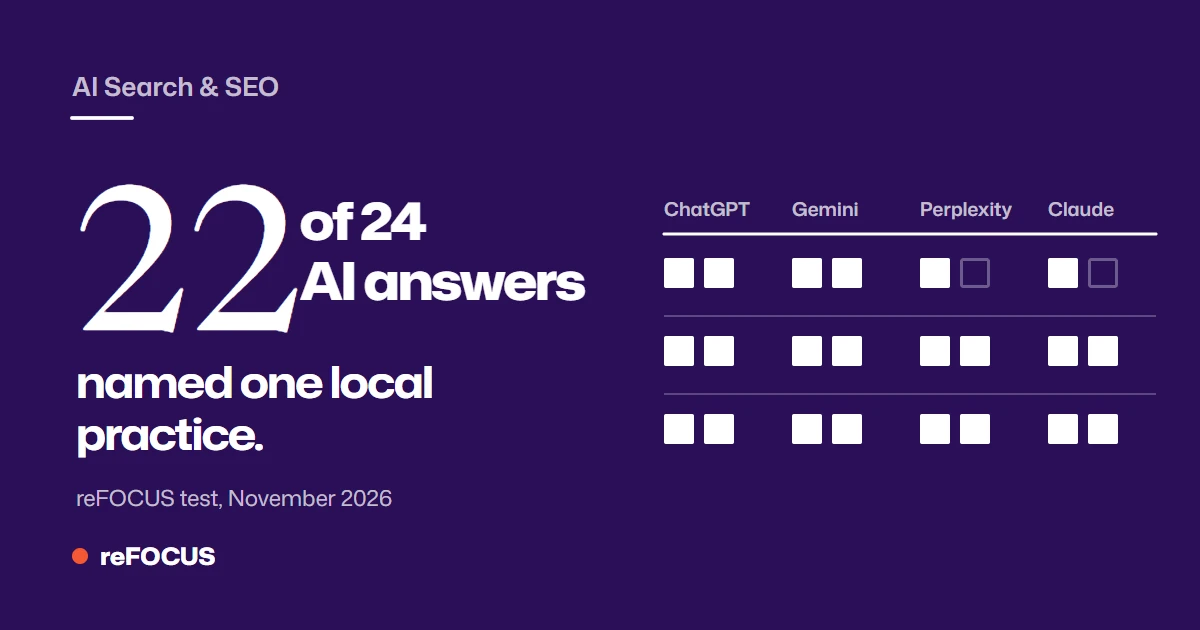
We asked each question twice in each assistant, with web search on, for 24 answers in total. Our client OSMC, a 40-year orthopedic practice in St. Joseph, was named in 22 of the 24. Its website was cited in all 24, including the two answers that listed surgeons without naming the practice.
Who the AI assistants named, 24 answers
22 of 24 answers named the practice
| Question | ChatGPT | Gemini | Perplexity | Claude |
|---|---|---|---|---|
| “Who is the best orthopedic surgeon in St. Joseph, Missouri?” | ChatGPT named OSMC in 2 of 2 answers. | Gemini named OSMC in 2 of 2 answers. | Perplexity named OSMC in 1 of 2 answers. | Claude named OSMC in 1 of 2 answers. |
| “Where should I go for orthopedic urgent care in St. Joseph, MO?” | ChatGPT named OSMC in 2 of 2 answers. | Gemini named OSMC in 2 of 2 answers. | Perplexity named OSMC in 2 of 2 answers. | Claude named OSMC in 2 of 2 answers. |
| “I hurt my knee playing basketball. Where can I get it looked at in St. Joseph, Missouri?” | ChatGPT named OSMC in 2 of 2 answers. | Gemini named OSMC in 2 of 2 answers. | Perplexity named OSMC in 2 of 2 answers. | Claude named OSMC in 2 of 2 answers. |
Named OSMCDidn't name OSMC, but cited its website
What we do for OSMC: we run their social media and their Google Business Profile, and we talk with their leadership every week. We advise them on reviews and their website, but we don't manage those directly. What we see is a practice that is consistent everywhere and talks the way its patients do.
The limits, plainly: this is one day in a small market, and OSMC has served that town for 40 years. AI answers also change from one run to the next, which is why we asked everything twice.
Bigger markets work differently. When we asked the same assistants about real estate brokerages in Tampa, they named national and regional brands such as Keller Williams, eXp and Coldwell Banker. For agents in Orange County, California, they named other agents with YouTube channels. In a crowded market, AI tends to repeat whoever the lists and directories already name. In a smaller market, a business that's clear and consistent online can become the default answer.
Start with the sites AI already cites
There's an old Wayne Gretzky line that marketers love: skate to where the puck is going. Andy Scherer, our founder, turns it around for AI search:
"In AI SEO, you actually want to see where the puck has been. How is AI search picking up on the stuff that it's citing? Develop a strategy around where it's been and what it's looking at, and even why it's looking at it."
AI already shows you what it trusts. Ask it the questions your customers ask, then look at the sources under each answer. In the OSMC answers, the assistants drew on:
OSMC's own website was the one source every answer used. The main competitor's website came up in 17 answers, listing and review sites in 14, Wikipedia in 11 and Reddit in 6. Your industry will have its own version: Avvo and Justia for law firms, Angi and the Better Business Bureau for home services, FINRA BrokerCheck for financial advisors, Zillow and Realtor.com for real estate agents. Ask the questions yourself and you'll see which ones matter in your market.
How do I get my business ranked on ChatGPT? Seven steps
These are in the order we'd do them. The first three cost nothing but time.
1. Check your name, address and phone number everywhere
"As stupid as it sounds," Andy says, this is the first thing he does with a new client. Search for your business on Google, Bing, Apple Maps, Yelp and the directories in your industry. Look at your website footer, your social profiles and the sign on your building. Then ask ChatGPT what it knows about you.
"You have no idea how common it is for something to be off," he says, "and that is one of the easiest fixes." An old suite number, a call-tracking phone number, "St." on one site and "Street" on another. Each mismatch gives AI a reason to doubt that the listings describe the same business.
Five-minute check: search your business name plus your town and open the first ten results. Do they all show the same name, address and phone number?
2. Update your Google Business Profile every week
Post an update at least once a week. Andy recommends three times a week: a recent job, a common question answered, a team member, a seasonal reminder. Keep your hours, services and photos current. A post from this week tells Google, and anyone checking, that someone is minding the business. It's one of the two things we run for OSMC, along with its social media.
Five-minute check: open your Business Profile. When was the last post? Are the hours and services right?
3. Write the way your customers ask
Andy was at his gym when he saw a physical therapist he knows doing an exercise he'd never seen. He asked what it was.
"His response was something about palmar flexion and radial/ulnar deviation. I had no idea what he was talking about, which he probably saw from my face. Then he explained it as tilting your wrist sideways, like you're waving or using a hammer. Now that I actually understood."
Your customers type questions into ChatGPT the way Andy asked his question at the gym. If your pages only use the professional term, there's nothing on them that matches the question.
Some examples of the gap (illustrations, not client results):
| Your industry's term | What a customer types |
|---|---|
| Premises liability (law) | "I slipped in a store and got hurt. Can I sue?" |
| Heat pump short cycling (HVAC) | "Why does my heat keep turning on and off?" |
| Sequence-of-returns risk (financial planning) | "What happens if the market drops the year I retire?" |
| Seller concessions (real estate) | "Can the seller help pay my closing costs?" |
Use both. Keep the correct term, and put the customer's question in a heading with the plain answer right under it.
Where the customer's words come from: the people who talk to customers every day. With OSMC, we talk with leadership every week, we hear the doctors' stories, and we write content in the words patients actually use. Any business can run the same loop. Once a week, ask your front desk, your sales team or your technicians: "What did people ask us this week, in their own words?"
Five-minute check: pick your most important service page. Does it answer, in plain words, the first question a new customer asks on the phone?
4. Get fresh reviews the same way, from everyone
We advise OSMC on reviews but don't run them, and this is the advice we give. Ask every customer for a Google review, in the same way and at the same point (when a job wraps up, say, or a week after a visit). Use the review link from your Business Profile, and send the same message to everyone.
Don't tell people what to write, offer anything in return, or ask only your happy customers. Google's review policy forbids incentives and "selectively" asking for positive reviews. The FTC's 2024 rule bans fake reviews, paying for positive or negative reviews, and insider reviews that don't disclose the connection.
You can still cover the common questions and situations your ideal customers have. Do it in your own words: in your replies to reviews, your Business Profile posts and your website. Medical practices have one more rule: never confirm in a reply that someone is a patient.
Five-minute check: how many Google reviews did you get in the last 90 days? If the answer is "a few," you don't have a system yet.
5. Let AI search tools read your site
ChatGPT's search uses a crawler called OAI-SearchBot. OpenAI's documentation says sites that block it "will not be shown in ChatGPT search answers," and its help center adds that placement "is not guaranteed." You can allow OAI-SearchBot and still block GPTBot, the crawler that collects training data, if you'd rather your content wasn't used for training.
Ask your web developer to check three things:
- your robots.txt file
- your firewall or security service, which sometimes blocks bots without anyone knowing
- that your key pages aren't set to "noindex"
While they're in there, ask them to add structured data (schema) that states your business name, type, address, phone and official profiles.
Five-minute check: open yourdomain.com/robots.txt. If you see "OAI-SearchBot" next to "Disallow," or "Disallow: /" under "User-agent: *", you're blocking it.
6. Earn a place on the lists AI reads
When someone asks for "the best" anything, AI leans on articles that list the best providers. When we tested our own industry in November 2026, at least four of the "best agency" lists AI cited were published by agencies on their own websites, ranking themselves. Find the lists that come up for your customers' questions (the "where the puck has been" section above shows you how), then ask to be considered, with real proof: reviews, results, years in business.
Ask for free inclusion. Some lists sell their top spots. We don't recommend paying unless you can show it brings in customers, much as you'd judge any paid placement.
Five-minute check: ask ChatGPT for the best [your service] in [your town] and open the lists it cites. Are you on any of them?
7. Test every month and keep screenshots
Once a month, ask ChatGPT, Gemini, Perplexity and Claude the five questions your customers ask most. Write down who's named and which sites are cited. Take dated screenshots.
Andy admits that OSMC's leadership and doctors are always the first to notice when they show up, "and no, we don't have a screenshot of that. We should absolutely do that in the future." Keep yours from the first month.
Seven steps to get recommended by AI
Tick a step when its check passes
0 of 7 done
Download the printable checklist (PDF)Google isn't dying, and you're not too late
Two things get said a lot in AI marketing. Andy disagrees with both.
"Google is dying." "Freakin Google is NOT dying," Andy says. "Is there traffic loss overall? Absolutely. And is search more than just Google? Yes. But Google isn't going anywhere anytime soon." In October 2026, Google handled 85% of searches in the United States and 91% worldwide (StatCounter). Most of the steps above help you on Google too.
"If you're not in early, you're screwed." "You're not," Andy says. "It's just a different way to be looking at your strategy and systems." Andy calls step 1 "one of the easiest fixes," and you can start it this week.
What this won't fix. AI recommendations are one more place customers look before they call. A good offer, steady referrals and a team that answers the phone still do the heavy lifting.
How long does it take? A new page can be picked up fast. In a 2025 Semrush test of 81 new pages, Google's AI Mode cited 36% within a day, and ChatGPT cited 42% within a month. Being recommended takes longer, because AI leans on reviews, listings and other sites that build up over months. Its sources also shift: Profound found in 2025 that about half the sites ChatGPT cited changed within a month. Plan in months, check every month, and keep the screenshots.
FAQ
How do I get ChatGPT to recommend my company?
Make your business easy to find, understand and confirm. Keep your name, address and phone the same everywhere. Keep your Google Business Profile active, collect reviews steadily, write pages in your customers' words, and make sure ChatGPT's crawler (OAI-SearchBot) can read your site.
Can I pay to be recommended by ChatGPT?
Not inside the answer. ChatGPT has shown ads since February 2026, but they sit below the answer, labeled as ads, and OpenAI says advertisers "have no ability to shape, rank, or alter ChatGPT's responses." Some of the "best of" lists AI reads do sell spots. We don't recommend buying one unless you can show it brings in customers.
How is AI search different from regular SEO?
Most of the foundations are the same: a clear website, consistent listings, reviews and links from trusted sites. The difference is that AI answers a question in one reply and names only a few businesses. Pages that answer real questions in plain words, and other sites that confirm who you are, matter even more.
Can a small business still show up in AI answers?
Yes. In our test, a 40-year local practice was named in 22 of 24 answers in its town. In crowded markets it's harder, because AI leans on lists that name the biggest brands.
Can I do this myself for free?
Yes, for most of it. Steps 1, 2, 3, 5 and 7 cost nothing but time. Reviews and list outreach take steady effort more than money.
Does ChatGPT use Google?
Not directly. ChatGPT runs its own search, and OpenAI says it sometimes sends queries to partner search providers, pointing to Microsoft's privacy statement. That's a good reason to keep your Bing Places listing current. Google's results feed Google's own AI Overviews and Gemini. Most of the seven steps help with all of them.
Related: What is AEO (answer engine optimization)? · OSMC case study · How to choose an orthopedic marketing agency
Sources:
- OpenAI Help Center, "Searching the web with ChatGPT" and "Ads in ChatGPT" (checked 2026-11-09)
- OpenAI, "Overview of OpenAI Crawlers," developers.openai.com/api/docs/bots (checked 2026-11-09)
- Federal Trade Commission, "Federal Trade Commission Announces Final Rule Banning Fake Reviews and Testimonials," August 14, 2024
- Google, "Maps User Generated Content Policy: Prohibited & restricted content," support.google.com/contributionpolicy/answer/7400114 (checked 2026-11-09)
- Semrush, "How fast do AI search platforms cite new content?" (81 test pages, 30 days), December 10, 2025
- Profound, "AI search volatility" (domains cited one month apart, June to July 2025)
- StatCounter, search engine market share, United States and worldwide, October 2026
- reFOCUS AI test, November 7, 2026: 3 questions, 4 assistants (ChatGPT, Perplexity, Gemini, Claude), 2 runs each, web search on, run through the DataForSEO AI Optimization API
- reFOCUS AI baseline, November 6, 2026: 57 questions about choosing a marketing agency, 4 assistants
- reFOCUS AI test, November 9, 2026: real estate questions for Tampa and Orange County, 4 assistants, 1 run each
Want to know what AI says about your business?
We'll ask the assistants your customers' questions, then show you who they name, which sites they cite and what we'd fix first.
Book a call