SEO for medical practices with several doctors and offices


The short answer
Short answer
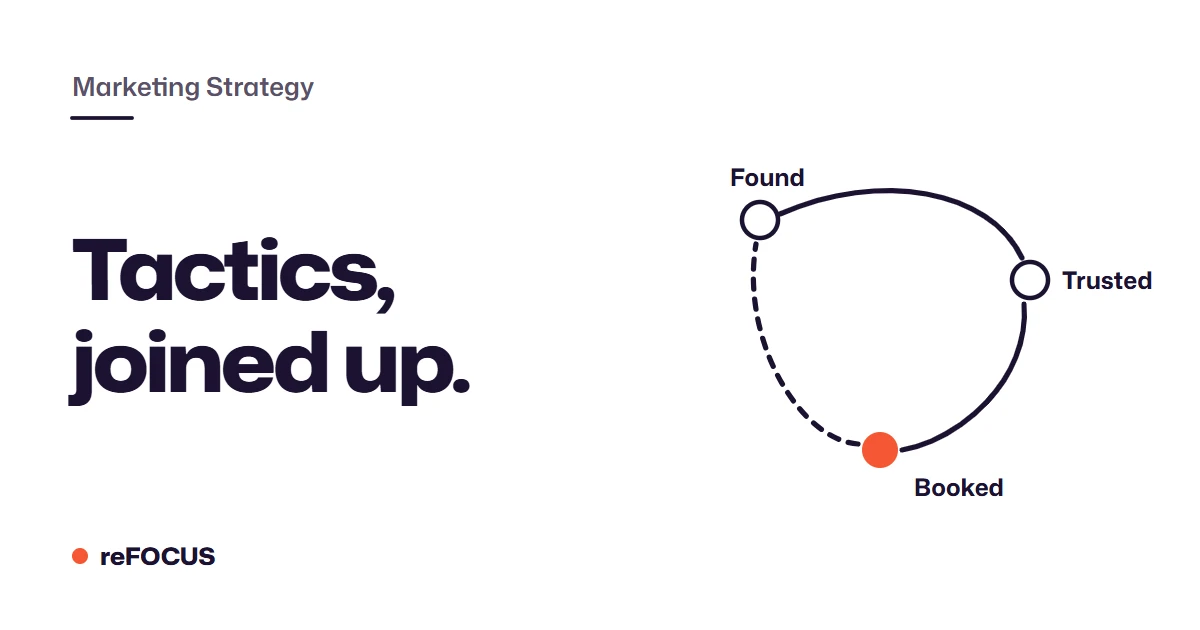
If your practice has several doctors and offices and doesn't come up on Google or in ChatGPT, the usual cause is that Google and AI tools can't confirm who you are, where you are, or that patients trust you. SEO for a group means fixing that office by office and doctor by doctor: your Google Business Profiles first, then reviews, then the same details on every directory, with your website built on top of that.
The good news is that it's fixable. When an administrator tells me their practice doesn't show up, I start with an audit of three things, and for whatever it's worth, the website isn't one of them:
- Google Business Profiles. One for each office, plus one for each doctor patients see there. Is each one claimed, in the right category, with correct hours and services, and kept up to date? For a practice with several offices, this is usually where the biggest gap is.
- Reviews. How many, how recent, and the star rating at each office. Patients filter on rating, and Google and AI tools both lean on reviews as proof you can be trusted.
- The same details on every directory. The same name, address and phone number on Healthgrades, Zocdoc, Vitals, Bing Places, insurance directories and your own site. AI tools rely on search indexes, directories and review sites. When the details conflict, they leave you out.
The website comes after these. A great site can't fix three unclaimed or conflicting office listings, and AI tools won't recommend a practice they can't confirm.
Key takeaways
- Start with one Google Business Profile per office, plus one for each doctor patients see there. Google's own guidelines set what's allowed.
- Ask every patient for a review, with a link to the office they visited, so no office looks empty.
- Build your service pages first. In my experience, they're the most efficient way to bring in organic traffic from search and AI answers.
- In our test, the client's own website was cited in all 24 answers, and listing and review sites came next.
- Keep Google first. In KFF's poll published March 25, 2026, 68% of adults had used a search engine for health information in the past year, and "about a third (32%) of adults are turning to AI for health information and advice." Fixing Google is step one of AI search.
Who owns your search presence when you have several offices
In a group, more than one team touches your search presence. MGMA put it this way: "the administrator, marketing lead, credentialing team and website vendor need the same source-of-truth discipline they would apply to payer enrollment, provider onboarding or referral leakage."
Most groups aren't there yet. In an MGMA Stat poll of medical group leaders on June 16, 2026 (a text-message poll with 218 applicable responses), 55% had no strategy for AI search visibility, 35% had one and 11% were unsure. The barriers they gave were, in MGMA's summary, "time, money, staffing, IT support and ownership."
I've seen what happens when nobody owns it. One practice we started working with didn't control its SEO or the information about it, and it had slid long before we got there. Nothing was being optimized. There were broken links, the pages didn't match each other, and the branding from one page to the next was faulty at best. That was only the start of it.
We took everything we found into an in-depth audit and put a 90-day plan in place to fix and optimize it. They started seeing changes within 21 days.
Five-minute check: write down who can edit each office's Google profile, the website and the doctor bios today. If anyone on that list has left the practice, start there.
One Google profile per office, and one per doctor patients see there
Google's rules for a practice with several offices and doctors are specific, so read them in Google's own words. From its guidelines for representing your business on Google:
- "Do not create more than one page for each location of your business, either in a single account or multiple accounts."
- "Doctors, dentists, lawyers, financial planners, and insurance or real estate agents are all individual practitioners."
- When a doctor is "one of several public-facing practitioners at this location", the practice creates a profile for that location "separate from that of the practitioner."
- The doctor's profile title "should include only the name of the practitioner, and shouldn't include the name of the organization."
- "Support staff should not create their own Business Profiles."
- "Use a local phone number instead of a central call center helpline number whenever possible."
- "All locations of a business must share the one category that best represents the business."
- "Including unnecessary information in your business name isn't permitted, and could result in the suspension of your Business Profile."
Google also says how it ranks these profiles: "Local results are mainly based on relevance, distance, and popularity." And it's blunt about shortcuts: "There's no way to request or pay for a better local ranking on Google."
The worst profile mess I've seen wasn't at a practice. I don't have a great example from one, so here's a real estate brokerage:
- They had moved offices, which left duplicate listings and split their reviews between them.
- None of the information was kept up to date, even on the new listing.
- On the one they did manage, not a single review had a reply.
- Nobody was posting.
- A former employee owned the profile, and nobody could get in to fix it.
- The services section was nearly blank.
Five-minute check: count the profiles for each office, compare each one's phone number with that office's local line, and confirm someone still on staff owns every one of them.
Which pages to build first
A lot of groups have one "services" page and a short bio for each doctor. If I could build only a few pages in the first month, I'd build the service pages first. The doctors usually won't like hearing that.
How you build them matters. For each service I look for everything particular to that practice:
- how they approach it and what their thought process is
- anything they do that nobody else does
- why patients choose them for that service
- the questions people usually ask when they're interested in it
I go in depth because service pages are the most efficient way to bring in organic traffic, whether it comes through AI engines or traditional search. MGMA makes the same point from the other side: "A single 'services' page listing 20 procedures gives both patients and machines little to work with."
Office and doctor pages come next. A medical site works best with a page for each location carrying real local detail, a page for each provider, and pages for the major conditions and treatments, all linked to each other. There's more on how we approach this on our page about marketing for medical practices. On doctor pages, state credentials exactly. Name the board when you write "board certified", and use the actual credential in place of "specialist" or "expert". Clear that wording with your compliance lead.
What AI assistants read when a patient asks about your practice
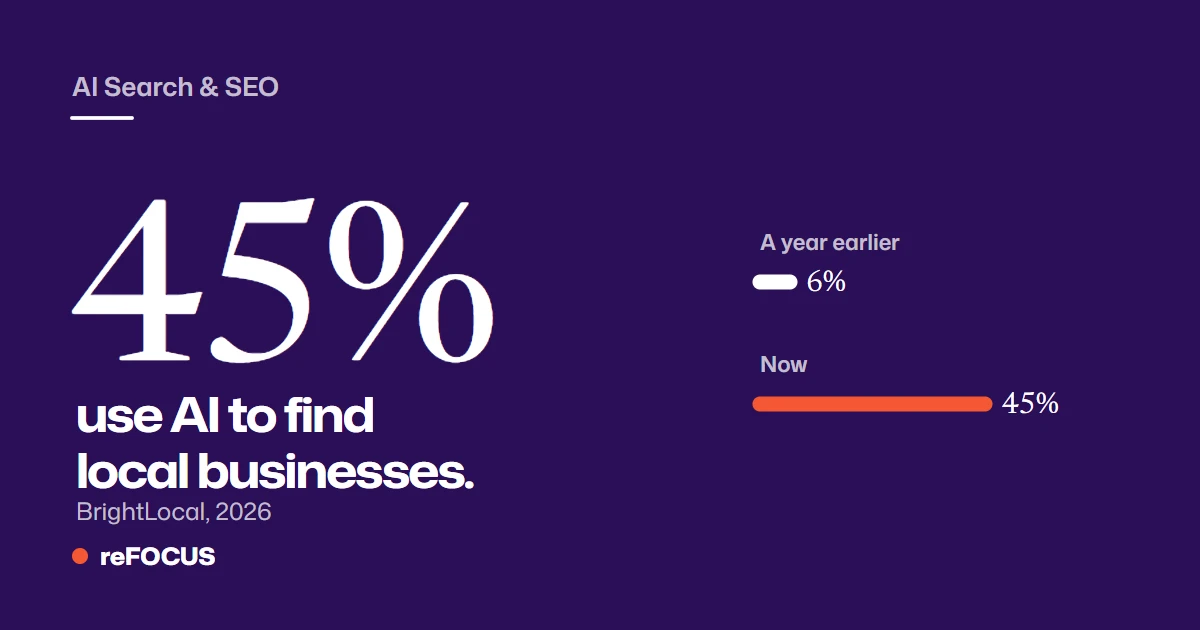
Patients are asking. In KFF's poll published March 25, 2026, "about a third (32%) of adults are turning to AI for health information and advice," and 16% said they had used AI in the past year "to get help deciding whether to see a doctor or seek medical care."
Much of what those tools read about your doctors sits on sites you don't run. In research by Halcy, published by MGMA on June 16, 2026, 77% of what ChatGPT cited about practices across 33,340 citation events was on sites other than the practice's own. Hospital staff rosters and specialty-association credentialing pages together made up 49.6%. Halcy sells AI-visibility services, so treat this as a vendor's study.
What we did for OSMC, in order
OSMC is a 40-year orthopedic practice in St. Joseph, Missouri. This is the order we worked in:
- A full audit of where they'd been: what was working and what wasn't.
- Their goals and targets for the practice.
- A full keyword and prompt analysis for their services, based on those goals.
- An audit of their current content for those keywords, on social, the website and Google.
- A plan mapping out content for those keywords and phrases.
- An optimization plan for the website.
- Then we started to execute.
On November 7, 2026, we asked four AI assistants (ChatGPT, Perplexity, Gemini and Claude) three questions a patient near St. Joseph, Missouri might ask:
- "Who is the best orthopedic surgeon in St. Joseph, Missouri?"
- "Where should I go for orthopedic urgent care in St. Joseph, MO?"
- "I hurt my knee playing basketball. Where can I get it looked at in St. Joseph, Missouri?"
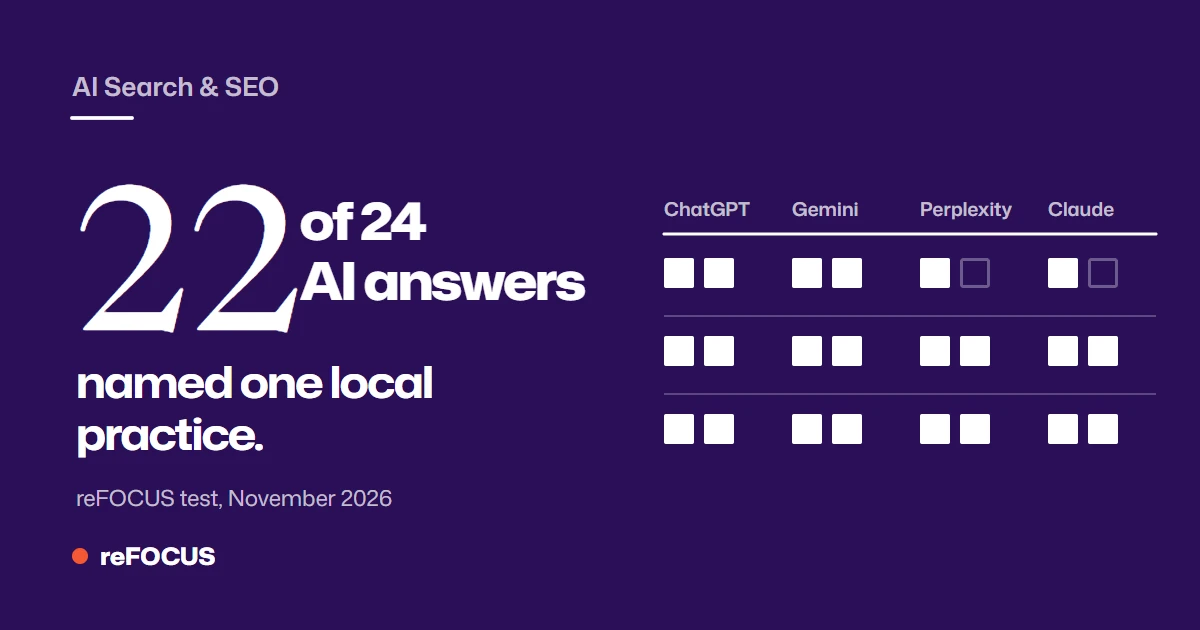
We asked each question twice in each assistant, with web search on, for 24 answers in total. Our client OSMC, a 40-year orthopedic practice in St. Joseph, was named in 22 of the 24. Its website was cited in all 24, including the two answers that listed surgeons without naming the practice.
Who the AI assistants named, 24 answers
22 of 24 answers named the practice
| Question | ChatGPT | Gemini | Perplexity | Claude |
|---|---|---|---|---|
| “Who is the best orthopedic surgeon in St. Joseph, Missouri?” | ChatGPT named OSMC in 2 of 2 answers. | Gemini named OSMC in 2 of 2 answers. | Perplexity named OSMC in 1 of 2 answers. | Claude named OSMC in 1 of 2 answers. |
| “Where should I go for orthopedic urgent care in St. Joseph, MO?” | ChatGPT named OSMC in 2 of 2 answers. | Gemini named OSMC in 2 of 2 answers. | Perplexity named OSMC in 2 of 2 answers. | Claude named OSMC in 2 of 2 answers. |
| “I hurt my knee playing basketball. Where can I get it looked at in St. Joseph, Missouri?” | ChatGPT named OSMC in 2 of 2 answers. | Gemini named OSMC in 2 of 2 answers. | Perplexity named OSMC in 2 of 2 answers. | Claude named OSMC in 2 of 2 answers. |
Named OSMCDidn't name OSMC, but cited its website
When we searched on November 2, 2026, OSMC was first in Google's local results for "orthopedic surgeon St. Joseph MO". On the same day, ChatGPT recommended OSMC surgeons first when asked who to see for orthopedic care in St. Joseph. When we searched again on November 22, 2026, OSMC was first in Google's local results for both "Orthopedic urgent care St. Joseph Missouri" and "Orthopedic surgeon St. Joseph MO".
The limits, plainly: this is one practice, one specialty and one town, and 24 answers. The full OSMC case study has the rest of the results, and our guide on how to get your business recommended by ChatGPT covers crawler access and the seven steps we'd take for any business.
"They took the time to learn our specific software and how it works, so our marketing strategy is built around what we actually do. … Our business now shows up in both Google and AI search results. It's nice to have a marketing partner we can trust." Cheryl Kidwell, CEO, Orthopedic & Sports Medicine Center
Fix the listings you don't own at the source
We've seen a picture of another doctor next to our doctor's bio. A wrong phone number. The right picture with the wrong bio. There's a ton we've seen AI engines get wrong.
"If a doctor left two years ago and three directories still list them at your office, AI tools will repeat that, because those directories are part of what they read."
Fix it at the source. In our experience, most of these directories copy their data from a few upstream records, so when you fix those, the corrections spread downstream.
- The doctors' own records. Start with each doctor's entry in the NPI registry (NPPES), their CAQH ProView profile and their state medical board listing.
- Hospital rosters. Send the medical staff office a written update whenever a doctor joins, leaves or changes offices. In our experience, they rarely catch it on their own.
- Specialty association directories. Each doctor logs into their member profile and updates the practice name, offices, phone and booking link. Usually only the doctor can do this, so it goes on the doctor's to-do list. The front desk can't do it for them.
- One person who owns it. Run a quarterly check of every doctor on every major directory. Add a join and leave checklist, so a new hire's profile goes live and a departed doctor's profile gets fixed in the same week.
Reviews from every office, within the rules
Google counts reviews in its local ranking, including "how many reviews you have". With several offices and a dozen doctors, the goal is a steady flow at every location. Here's how I'd set it up:
- Build the ask into every visit. An automatic text goes out within a few hours of checkout. Most patients just never get asked.
- Send each patient to the right office. The text links to the Google profile for the office they visited, and to the doctor's own profile where one exists. That keeps reviews spread across your locations.
- Give the front desk one line for checkout: "You'll get a text from us. If we took good care of you today, a quick review really helps." In my experience, that one line lifts response rates.
- Track it monthly, by office and by doctor. Any office or doctor that falls behind gets attention that month.
- Reply to every review, good and bad.
And here's what goes wrong:
- One review link for every office. All the reviews land on the main location, and the other offices look empty.
- Asking only the happy patients, or sending unhappy ones somewhere else first. That's called review gating, and it breaks Google's rules.
- Bursts, then silence. A big push, then nothing for months. Patients and Google both notice when reviews stop.
- Offering incentives. They aren't allowed.
- HIPAA slips in replies. A reply that confirms someone was a patient ("Sorry your knee surgery didn't go well") is a privacy problem. Keep replies general and take the details offline. Never confirm in a reply that the reviewer is a patient, even when the review is positive.
Before the texts go out, walk your compliance lead through how and when you ask.
How to tell whether it's working, and how long it takes
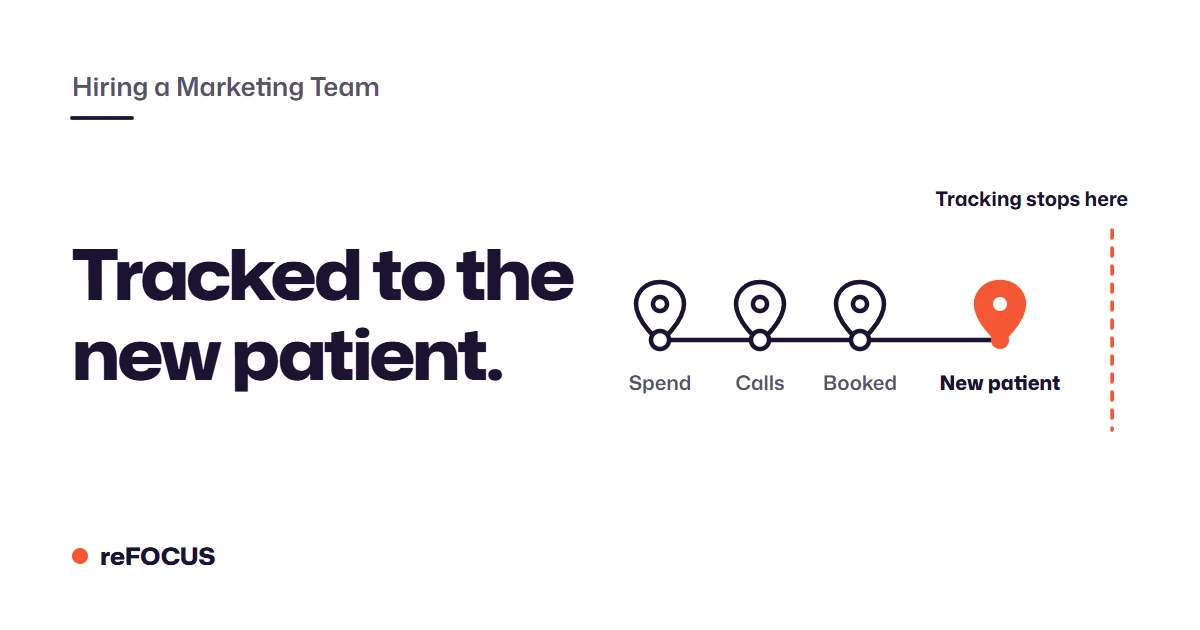
What we report each month is set by each client's goals, but we always tie the leading indicators to the lagging ones. We can show clicks, calls, email open rates, followers, views and landing page visits, and we show rankings in search and in AI engines too. Those are good leading indicators, especially for spotting trends. They tie directly into appointments, walk-ins where a practice takes them, and new patients. We also show conversion ratios from every source, so we can make decisions together based on the data, along with cost per patient lead and cost per acquisition. If you want to see which numbers to keep and which to drop, read the five marketing metrics that matter.
You can run your own AI check every month. Ask the assistants the questions your patients ask, write down who's named and which sites are cited, and keep dated screenshots. That's how we ran our own test. The free diagnostic does this for you, against your top three competitors.
One more item for your compliance lead: have them check which tracking scripts run on your booking, intake and patient portal pages.
On timing, it varies. OSMC started seeing more map visibility and calls in about 30 days. Others take longer, especially in competitive markets or where the profiles were a real mess. The map usually moves first, front-desk calls follow it, and AI answers catch up last. Here's how I'd rank what you fix, fastest first. These ranges come from our own client work, not from measured averages:
What you fix and when you usually feel it
- Missed-call text-back, a 5-minute follow-up and after-hours (AI) coverage: 1 to 2 weeks
- Reaching your existing patient list again by email (or text, where that applies): About 2 weeks
- Paid ads (Google Search, Local Services Ads and Meta): First inquiries in about 21 days, because of setup
- Google Business Profile cleanup: 2 to 6 weeks. OSMC saw a difference about 30 days in
- A review engine: 2 to 3 months, give or take
SEO and AEO, social, directory and roster cleanups and landing page work take longer than any of these.
FAQ
How long does SEO take for a medical practice?
It varies with your market and how messy your profiles are. In my experience, a Google Business Profile cleanup usually shows in 2 to 6 weeks, and a review engine in 2 to 3 months. SEO, AEO and directory cleanups take longer. The map usually moves first, calls follow, and AI answers catch up last.
Does each doctor need their own Google Business Profile?
Google treats doctors as individual practitioners. Where a doctor is one of several public-facing practitioners at an office, the practice keeps a profile for that office, separate from the doctor's, and the doctor's profile carries only the doctor's name. "Support staff should not create their own Business Profiles."
Can a practice pay for a better ranking on Google?
No. Google's help page says, "There's no way to request or pay for a better local ranking on Google."
Is AI search worth our time yet, or should we fix Google first?
It's worth your time. We're moving to a zero-click digital economy: people search in Google and get AI Mode answers, and the same is happening on other platforms. Others use ChatGPT or Claude as a modern search engine. I'd call it a necessity. SEO is still the foundation you build on, and you don't have to choose between the two. Fixing Google is step one of AI search, because AI tools pull from the same places: your profiles, directories, reviews and other sites. Get that right, then build the content that gets you named in the answers.
What does SEO for doctors cost?
It depends on how many offices and doctors you have and how much needs fixing. Our article on how much SEO costs explains what drives the price, and the diagnostic shows the price of a six-month plan for your practice.
Sources
- MGMA Stat, "Can AI find your practice when patients ask?", poll of June 16, 2026, published June 17, 2026 (218 applicable responses)
- KFF Tracking Poll on Health Information and Trust: Use of AI for Health Information and Advice, published March 25, 2026
- Google Business Profile Help, "Tips to improve your local ranking on Google" (support.google.com/business/answer/7091), read November 16, 2026
- Google Business Profile Help, "Guidelines for representing your business on Google" (support.google.com/business/answer/3038177), read November 16, 2026
- Nathan Woo (Halcy), "Where ChatGPT gets its answers", published by MGMA, June 16, 2026. The author's company sells AI-visibility services
- reFOCUS AI test, November 7, 2026: 3 questions, 4 assistants (ChatGPT, Perplexity, Gemini, Claude), 2 runs each, web search on, run through the DataForSEO AI Optimization API
See where your practice stands today
Before you spend more on ads or a new website, find out where each office already stands. Run the free diagnostic to see how your practice shows up on Google, the map and AI assistants next to your top three competitors.
Want a plan like this for your business?
Run the free diagnostic. It takes a few minutes, and you'll see a six-month plan with the price.
Book a callWant a plan like this for your business? Run the free diagnostic. It takes about 10 minutes.